
Dehydrated Vegetable Specifications: Moisture, Mesh, Color & Rehydration Reference
This article serves as a technical specification reference for procurement teams, food R&D engineers, and quality control managers evaluating dehydrated vegetable products. Specifically, we focus directly on physical product parameters. We will break down exactly what you should measure, what numbers you can expect, and how each parameter affects your finished product.
However, if you are looking for certification frameworks like HACCP, ISO 22000, and BRC, please see our other guide. Therefore, you can check our detailed reference under quality standards, certifications and testing for dehydrated vegetables.
1. Why Physical Specifications Matter
Standardized physical specifications allow R&D teams to compare different suppliers accurately. Furthermore, establishing these parameters successfully prevents costly batch-to-batch variation on automated production lines. Without clear guidelines, food manufacturers often face inconsistent rehydration behavior. Consequently, they suffer from color drift in finished goods and processing issues on dosing equipment.
Therefore, locking in precise physical specifications upfront remains essential. For seasoning manufacturers, instant noodle producers, and ready-meal factories, this proactive step works perfectly. In fact, it serves as the single most effective way to ensure a stable, high-quality production output.
2. Moisture Content by Product Category
Moisture content directly determines shelf life, microbial stability, and flowability in dry-blending operations. Consequently, different vegetable categories carry different industry-standard moisture ceilings:
- Garlic products (powder, granules, flakes): ≤6.5% — This low level ensures stable storage. Furthermore, it actively prevents caking in fine mesh sizes.
- Onion products (white onion, green onion/scallion): ≤7% — Green onions require a slightly higher allowance. This is necessary to preserve their natural chlorophyll color.
- Root vegetables (carrot, beetroot, sweet potato): ≤8% — Their higher natural sugar content safely tolerates a slightly higher residual moisture level.
- Leafy greens (spinach, celery, parsley): ≤8% — Producers prioritize vibrant color retention over the deepest possible drying.
- General industrial baseline: 6%–10% depending entirely on your intended application.
Generally, lower moisture extends shelf life. However, achieving this also increases dehydration costs. In addition, it raises total factory energy input. Because of these factors, buyers running infant food or pharmaceutical-grade applications often specify a strict ≤5% moisture limit. Therefore, they usually demand additional COA verification.
3. Mesh Sizes and Their Applications
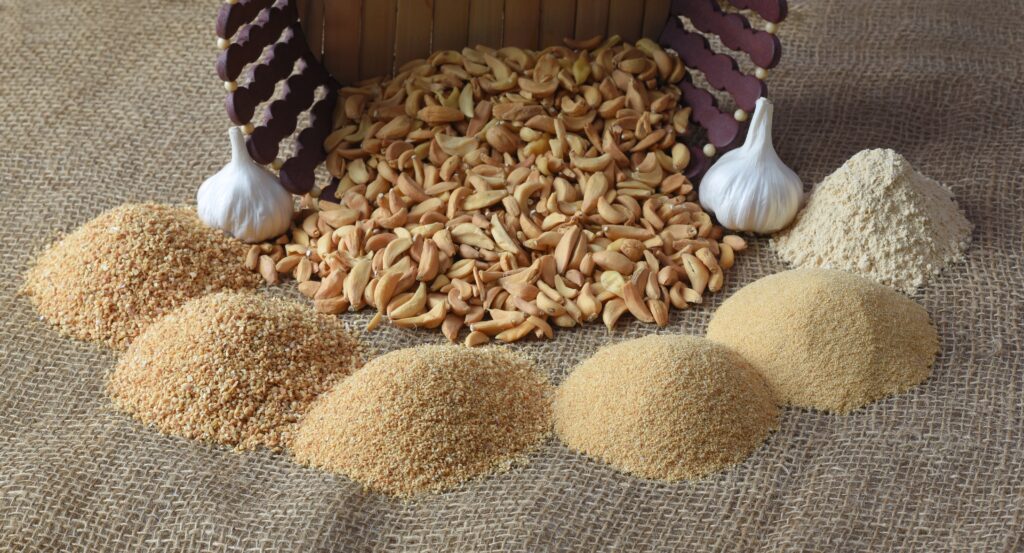
The term “mesh” refers to the particle size distribution measured by standard industrial sieves. Today, factories use the following standard ranges for dehydrated vegetable products:
- 8–16 mesh (coarse granules): Ideal for hearty soups and retorted ready meals. Consequently, they provide highly visible vegetable pieces.
- 16–26 mesh (medium granules): This is the most-requested range. Specifically, it fits seasoning blends, dry soup mixes, and meal kits.
- 26–40 mesh (fine granules): Perfect for instant noodle sachets. Therefore, it suits rapid rehydration applications.
- 40–80 mesh (ultra-fine): Excellent for sauce premixes and seasoning bases. As a result, it ensures an even color distribution.
- 80–120 mesh (powder): Standard garlic and onion powder. It works perfectly for smooth sauces, marinades, and dry-rub seasonings.
A typical specification usually reads as “20–40 mesh with ±2 mesh tolerance.” This means at least 90% of the particles must fall within the stated range during sieve testing. While a tighter tolerance increases unit costs, automated dosing equipment absolutely requires it.
4. Color Grading Standards
Quality teams grade color visually against industry color charts. In addition, they verify results spectrophotometrically for premium applications. Common industry grades include:
- Grade A (Premium): This grade features a uniform natural color that perfectly matches the reference standard. Consequently, it shows zero discoloration or dark spots from heat damage.
- Grade B (Standard): This tier allows for minor color variation (≤5% of the batch). Therefore, it suits sauce or seasoning applications where the final product color naturally masks variations.
- Sulfur-treated vs. sulfur-free: Sulfite dipping artificially brightens colors. However, it creates severe EU labeling problems. In addition, it triggers Japanese import restrictions, so you must always verify the SO₂ status.
5. Rehydration Ratio
The rehydration ratio measures how much water the dried product absorbs to return to its natural state. Therefore, it directly affects the final product yield in commercial soups, sauces, and ready meals:
- Carrot granules: 1:6 to 1:8 dry weight to water ratio.
- Onion / green onion: 1:5 to 1:7 absorption capacity.
- Garlic granules/flakes: 1:4 to 1:5 rehydration standard.
- Bell pepper: 1:7 to 1:9 ratio.
- Spinach / leafy greens: 1:8 to 1:10 maximum yield.
To run a standard rehydration test, simply soak the product in 40–60°C water for 10 minutes. If a lower-quality product rehydrates slowly, this behavior often indicates over-drying. Alternatively, it can show excessive cell-wall damage during factory processing.
6. Water Activity (aw)
Water activity (aw) is a critical technical parameter that predicts microbial safety. Less experienced buyers often overlook it, yet bacteria cannot grow below aw 0.85. Furthermore, yeasts and molds stop growing below aw 0.70.
High-quality dehydrated vegetables typically meet these strict targets:
- Dehydrated vegetables (general): aw ≤ 0.60 standard.
- Powdered products: aw ≤ 0.50 to secure an extended shelf life.
Ultimately, water activity predicts shelf stability more reliably than moisture percentage alone. Therefore, when evaluating new suppliers, you should always request water activity data alongside standard moisture content.
7. Bulk Density and Particle Size Distribution
Bulk density directly affects packaging size, container loading, and dosing accuracy on automated production lines. Typical bulk density ranges include:
- Granules (16–40 mesh): 0.45–0.60 g/cm³ standard.
- Powder (80–120 mesh): 0.50–0.70 g/cm³ density.
- Flakes: 0.20–0.35 g/cm³ standard range. This lower range results from their irregular shape.
Meanwhile, Particle Size Distribution (PSD) describes the uniformity within a specified mesh range. A “90% within range” PSD works perfectly for most B2B applications. On the other hand, infant food and pharmaceutical applications require a tighter 95% or higher standard.
8. What to Confirm Before Placing an Order
Before proceeding with a bulk purchase, buyers should safeguard their production lines. Therefore, you must request specific technical documentation from your supplier.
First, ask for a detailed technical specification sheet covering all parameters listed above. Second, demand a recent Certificate of Analysis (COA) confirming moisture, water activity, and microbial counts. Finally, request a particle size distribution report from independent sieve testing, a color reference photograph, and a physical sample for R&D laboratory verification.
Once you confirm these physical specifications, you can safely proceed to the next step. Specifically, verify the supplier’s certification framework and testing documentation to ensure full regulatory compliance.
9. Sample Specification Sheet Template
Below is a sample specification block our team provides with every commercial quotation. Qualified suppliers should easily provide this level of detail to your team:
- Product Name: Dehydrated Carrot Granules
- Botanical Name: Daucus carota L.
- Processing: Air Dried (AD)
- Moisture: ≤ 8.0% maximum
- Water Activity (aw): ≤ 0.60
- Mesh: 16–26 mesh, with a ±2 mesh tolerance
- Color: Grade A, bright orange
- SO₂: Not detected (completely sulfur-free)
- Rehydration Ratio: 1:6 to 1:8
- Shelf Life: 24 months total
10. Need Custom Specifications or Samples?
GuoJu Foods provides full technical transparency to international procurement and R&D teams. Specifically, we supply detailed specification sheets for all dehydrated vegetable items. Furthermore, we provide transparent, per-batch COA documentation.
In addition, we offer customized moisture, mesh, and color specifications tailored to your brand. Finally, we provide R&D sample support including multi-mesh comparison sets.
👉 Contact our team for technical documentation and samples
FAQ
What is the ideal moisture level for dehydrated vegetables?
Industry-standard moisture levels vary by category. For example, garlic products require ≤6.5%, whereas onion products require ≤7%. In addition, root vegetables require ≤8%, and leafy greens require ≤8%. While lower moisture extends shelf life, it also increases processing costs.
What does mesh size refer to?
Mesh refers to the particle size distribution measured by standard industrial sieves. Generally, higher mesh numbers indicate finer particles. Common commercial ranges include 8–16 (coarse granules), 26–40 (fine granules), and 80–120 (powder).
What is water activity and why does it matter?
Water activity (aw) measures the free water available to support microbial growth. High-quality dehydrated vegetables should test at aw ≤ 0.60. Consequently, this parameter serves as a more reliable shelf-stability indicator than moisture percentage alone.
What rehydration ratio should I expect from dehydrated carrots?
The standard rehydration ratio for dehydrated carrot granules ranges from 1:6 to 1:8 by weight. You can easily test this by soaking them in 40–60°C water for 10 minutes. However, other vegetables will vary based on their cell structure.
How do I verify a supplier’s specifications are accurate?
First, request a recent third-party COA from an accredited lab like SGS or CTI. This is better than relying solely on in-house reports. Second, request a physical sample so your R&D team can independently verify moisture, mesh, color, and rehydration behavior.